In a press release recently issued by Qualcomm, the company states that it's taking direct aim at the sub-$150 smartphone market with a new chipset on offer. The platform -- known as the MSM7227 -- is apparently designed with higher-power, lower-cost handsets in mind, offering HSDPA / HSUPA radios, a 600MHz CPU, 320MHz application DSP, 400MHz modem processor, hardware-accelerated 3D graphics, Bluetooth 2.1, and gps support integrated in a 12mm x 12mm chipset. The MSM7227 can also supposedly handle 8 megapixel camera and 30 FPS WVGA encoding / decoding with ease, and is capable of supporting Android, S60, Windows Mobile, and BREW platforms. Given the company's recent foray into Snapdragon and other pricier options, it's interesting to see them taking a shine to the low end of the market. We know that ASUS are planning on launching a cheaper Eee phone sometime soon, and they're currently snuggling up to qualcomm for chip duty on an Android device. Is this the year we'll see the rise of the smartphone version of the netbook (cheap, plentiful, almost disposable)? Only MWC knows for sure.
Showing posts with label Cellphones. Show all posts
Showing posts with label Cellphones. Show all posts
Saturday, February 14, 2009

Wednesday, February 4, 2009
AT&T reportedly eyeing post-merger Verizon Wireless assets
As you may recall, one of the requirements that Verizon had to agree with in order to complete its little acquisition of Alltel was that it must offload some $3 billion in wireless assets to avoid becoming too monolithic, and it looks like there's already a number of bidders angling for a piece of the action. The biggest of those, by far, is AT&T, which is apparently looking to pick up as big a chunk of the assets as it is able to and, according to The Wall Street Journal, it's in a good position to do just that. Other interested parties reportedly include a joint bid from the Carlyle Group and Kohlberg Kravis & Roberts & Co, a separate bid from Providence Equity Partners LLC, and at least one unnamed cable provider. Any of those bids, however, would still be subject to approval by the Department of Justice, with AT&T sure to draw the most scrutiny of the lot.
Vodafone reports 14 percent rise in revenue
Things may not be entirely awesome for most operators these days, but at least Vodafone's making some cash in this cash-strapped market. according to its most recent quarterly results, the outfit has notched a 14 percent increase in revenue, which was helped by the weak pound and exceptional sales in India. More specifically, it realized sales of ?10.47 billion ($14.9 billion) compared to ?9.16 billion ($13.06 billion) a year prior. Also of note, Voda was thanking data revenue profusely, as said category rose over 25 percent on an organic basis. Nevertheless, the good news prompted it to raise its expectations for the next quarter, which ain't happening too often these days. All the minutiae is parked in the read link.
Saturday, January 17, 2009
Why Obama's cell phone calls will always go through
After Barack Obama is sworn in next week, he'll be able to enjoy one of the lesser-known benefits of the presidency: phone calls that always go through. That means no more "all circuits are busy" messages. And no waiting for calls to be completed as millions of people crowd into Washington during the inauguration and jam overburdened cell phone towers, despite what have been practically heroic efforts on the part of carriers to add capacity. It may sound a bit like a storyline from the West Wing, but there actually is a branch of the government called the National Communications System tasked with ensuring that telecommunications related to "national security" remain intact and ready to use. President Kennedy created NCS in 1963, and its mandate has expanded to include high-priority Internet and mobile phone calls too. "We found that this program was very helpful during September 11," said Robert Kenny, director of media relations for the Federal Communications Commission's Public Safety and Homeland Security Bureau. "We think it's necessary across the board at all levels of government." Kenny said in an interview this week that NCS' priority-call system, which has been moved from the Defense Department to Homeland Security, is "for emergencies and other times there's a need to get calls out." That's in addition to private Defense Department networks, some of which are satellite-based. Homeland Security did not respond to queries about NCS on Thursday. One of the NCS's offerings is called Government Emergency Telecommunications Service, or GETS, which gives federally approved users special calling cards with instructions to call a certain number in the 710 area code for a guaranteed priority connection. At the prompt, the user enters a 12-digit ID number and the destination phone number. (The 710 area code is reserved for the federal government's exclusive use. It is, of course, a free call from a pay phone.) NCS says that the GETS system is designed to support tasks including "presidential communication," continuity of government, and access to the emergency broadcast system. Once the ID number is verified, the telephone network marks the call as a high-priority one, meaning it's specially routed and exempt from being blocked because of congestion or network overload. A 1984 executive order signed by President Reagan lists NCS's duties as: "National security and emergency preparedness communications for the federal government under all circumstances, including crisis or emergency, attack, recovery and reconstitution." In 2001, the government added an additional high-priority system for mobile phone users. It's called Wireless Priority Service, and gives authorized users including what NCS calls "senior members of the presidential administration" a higher-priority connection to the cell tower. WPS is accessed by dialing *272 before the destination phone number--but, alas, will only work if your mobile provider has authorized your phone. And the federal government needs to approve. "In times of an emergency that's a huge advantage for public safety," said John Taylor, a Sprint spokesman. Taylor said that WPS will come in handy next week during the inauguration. "For the inauguration, we are planning for 2 million people," he said. "We've said up front, if there are more than 2 million people, our customers will have problems. But we're confident public safety will not have problems because of this service." FCC documents (PDF) from 2000 provide a glimpse at the deliberations during the wireless system's creation. The agency concluded that a uniform *272 number was useful because otherwise "communications service users would have to change systems under conditions when compatibility is most important, i.e., during the exercise of the president's war powers." (As a side note, those war powers are breathtakingly expansive: Federal law allows the commander-in-chief to seize all TV and radio stations and cell phone towers, and control all telephone companies, Internet broadband providers and peering points. This can happen if the president believes there's a "threat of war" and such action is "necessary.") Authorization to use WPS is ranked by five different levels. The highest priority is reserved for, according to NCS, "National Command Authority support for military command and control critical to national survival" and "support for the conduct of diplomatic negotiations critical to arresting or limiting hostilities." Law enforcement and public utility companies receive a lower-priority WPS status. If Obama does end up ditching his BlackBerry for General Dynamics' Sectera Edge, a combination phone-PDA that's been certified by the National Security Agency, he won't be the first government employee to use it for priority calls. "Priority services as well as other security elements were considerations in the design of the device," according to a spokesperson for General Dynamics. The NCS has also taken some steps to find similarly-bulletproof ways to prioritize Internet communications. It's a far harder problem, of course, because the protocols underlying the Internet lack a reliable way to mark communications as White-House-high-priority, and the network is packet-switched and far less centralized. A 2004 report lists responses from the Internet industry to the NCS's request for suggestions about prioritizing governmental data communications including video chats and voice over Internet Protocol, or VoIP. It admits that "NCS cannot cause a paradigm shift within the Internet to meet these goals," one of which is "national leadership must receive end-to-end priority treatment over other users." It concluded, sensibly, that more research was required.
Sunday, December 21, 2008
Cellphone hacked to analyze blood, detect diseases on the spot

Not that the whole using-cellphones-for-disease-detection is completely fresh, but the latest handset hack for medical purposes is still mighty impressive. UCLA researcher Dr. Aydogan Ozcan has essentially converted a standard cellphone into a portable blood tester of sorts, which is capable of detecting HIV, malaria and various other illnesses. Put as simply as possible, the device works by analyzing blood cells that are placed on an integrated off-the-shelf camera sensor and lit up with a filtered light source. Said light source exposes unique qualities of the cells, and from there, the doc's homegrown software interprets the data and determines what's what. So, has anyone given this guy the main line to NTT DoCoMo, or what?
- Clevo laptop shocker! Scores of new, cryptic model names
- ThinkPad W700 surfaces with secondary 10.6-inch LCD
Sunday, December 14, 2008
Microsoft's First Ever iPhone App
Yesterday evening, Microsoft quietly added the photo displaying app SeaDragon Mobile, its first-ever iPhone application, to the App Store. Could Microsoft Office for iPhone be far behind? Probably not, but this is a start. SeaDragon Mobile is pretty much a demo of Microsoft Live Labs' photo display platform (also seen in Photosynth). Users can use the app to zoom in on photos with incredible resolution. The app achieves this by storing different resolutions, and shows only the portions needed at any given time. When explaining the decision to use the App Store, Alex Daley, group product manager for Microsoft Live Labs, said he was impressed with the iPhone's superior hardware.
The iPhone is the most widely distributed phone with a (graphics processing unit). Most phones out today don’t have accelerated graphics in them. The iPhone does and so it enabled us to do something that has been previously difficult to do. I couldn’t just pick up a BlackBerry or a Nokia off the shelf and build Seadragon for it without GPU support.It's the new Ray Ozzie Microsoft, right?
Friday, November 14, 2008
Qualcomm throws in the towel on UMB, 4G race down to LTE and WiMAX
Realistically, the death knell tolled long ago for Qualcomm's stillborn Ultra Mobile Broadband initiative, its own special flavor of 4G and the logical next step in the CDMA2000 family of technologies. To make things nice and official, though, they went ahead and officially announced that they've halted development on the spec during an analysts' meeting earlier today, throwing support behind the competing LTE standard -- one of the two remaining techs vying for the hearts and minds of the world's 4G-wanting public. So where's one of the world's great patent enforcers going to collect cash now? Oh, don't worry about little ol' Qualcomm; the company claims it has plenty of 4G-relevant intellectual property that'll keep its bankrolls full for years to come.
[Via: dailywireless.org ] [Tag: 4g, breaking news, BreakingNews, lte, qualcomm, ultra mobile broadband, UltraMobileBroadband, umb ]
[Via: dailywireless.org ] [Tag: 4g, breaking news, BreakingNews, lte, qualcomm, ultra mobile broadband, UltraMobileBroadband, umb ]
Saturday, November 8, 2008
AT&T picks up Centennial Communications for $944 million
For those who stick to one coast or the other, you may have never even heard of Centennial Communications. Not to worry, though, as AT&T just made said company entirely more relevant. Shortly before heading out of the office on Friday, AT&T decided it fitting to acquire Centennial for a few bucks shy of a billion, or $944 million for those seeking precision. The transaction will beef up AT&T's coverage for customers in rural areas of the Midwest and Southeast United States, not to mention in Puerto Rico and the US Virgin Islands. As always, the acquisition must first pass regulatory approval, the approval of Centennial's stockholders and "other customary closing conditions" before the little guy's 1.1 million subscribers officially make the shift, but we certainly don't expect that to be an issue.
[Via: The New York Times ] [Tag: acquire, acquisition, ATT, business, Centennial, Centennial communications, CentennialCommunications, deal, industry ]
[Via: The New York Times ] [Tag: acquire, acquisition, ATT, business, Centennial, Centennial communications, CentennialCommunications, deal, industry ]
Friday, November 7, 2008
Samsung steals Motorola's claim to fame, takes number one spot in US phone sales
No matter how dire Motorola's situation may be, it's still been able to cling to one last title keeping it firmly entrenched in the ranks of the world's mobile manufacturing elite: US phone sales. For years, Motorola has ridden the RAZR gravy train to success on its home turf more than any other, keeping more globally relevant rivals like Nokia and LG at bay. No longer, though -- Samsung has finally dethroned Moto, upping its share of the US market to 22.4 percent from 16.2 percent a year ago. That leaves Motorola in number two with 21.1 percent, a shocking fall from 32.7 percent in 2007. LG's knocking on the door at 20.5 percent, so unless the boys and girls in Chicago can get their Android-supportin' butts in gear on the double, we could see a drop to number three within a quarter or two.
[Via: Engadget ] [Tag: motorola, samsung, us ]
[Via: Engadget ] [Tag: motorola, samsung, us ]
Thursday, November 6, 2008
Analyst says Palm burning through cash like it's going out of style
Stock downgrades are nothing new for the boys and girls at Palm, but analyst Tavis McCourt of Morgan Keegan (which certainly sounds like an important and all-knowing firm) has painted a particularly bleak picture of the company's books today -- so grim, in fact, that it set off a 20 percent drop in the company's market cap. Apparently the big concern is Palm's cash burn rate, which has left a cash reserve of just under a quarter billion dollars through a series of delays and setbacks that have been partially offset by moderate successes like the Centro. McCourt figures that'll be down to a mere $75 million by the time Palm OS 2 launches, and that's assuming they don't run into any more slips in the schedule. He notes that Bono can always just flip 'em a few more mil out of his Joshua Tree earnings, but it'll end up diluting existing shareholders' stakes, hence the massive drop in value today. No pressure, Palm.
[Via: Engadget ] [Tag: cash, money, palm, stock ]
[Via: Engadget ] [Tag: cash, money, palm, stock ]
Tuesday, November 4, 2008
Nokia announces layoffs with flowery language
Hiding behind a press release titled "Nokia continues its change and renews some of its activities," the woodsmen of Espoo are swinging a corporate axe of woe. In total, the mobile phone giant plans to cut something on the order of about 600 jobs in its Sales and Marketing, R&D, and global operations. Nothing compared to the cuts at Motorola but certainly unwelcome news for those affected.
[Via: Engadget ] [Tag: layoff, layoffs, nokia ]
[Via: Engadget ] [Tag: layoff, layoffs, nokia ]
Wednesday, October 29, 2008
Motorola expected to cut more jobs as it simplifies around Android
Ugh, it looks like Thursday is shaping up to be another sad Moto day. The Wall Street Journal is reporting this morning that Sanjay Jha, former Qualcomm exec and Motorola co-CEO tasked with resurrecting Motorola's mobile-devices division, is about to slash jobs in an effort to bring costs and production under control. Though obviously unwelcome news, it likely won't come as a surprise to employees since Jha reportedly told them that Motorola has two to three times as many employees working on individual projects compared to its competitors. Cuts will likely number in the "thousands," according to the WSJ's sources, and could come as early as Thursday when Motorola announces earnings... or more likely, lack thereof. Motorola has already shed 10,000 jobs since the start of 2007. In addition to job cuts, Jha plans to "scrap dozens of phone designs" while scaling back its mobile-OS inventory from more than a half-dozen to just three: Android for multi-media and Internet showcase phones, Windows Mobile for ho-hum business devices, and its own P2K for low-end phones. Moto will likely outsource at least some of its WinMo phone production as well. As to his motivation: $100 million and 3 percent stock if Mr. Jha manages to spin-out the mobile devices division into an independent company by late 2010. $30 million if he fails. Win-win, eh Sanjay?
[Via: Engadget ] [Tag: android, google, motorola, p2k, sanjay jha, SanjayJha, windows mobile, WindowsMobile, winmo ]
[Via: Engadget ] [Tag: android, google, motorola, p2k, sanjay jha, SanjayJha, windows mobile, WindowsMobile, winmo ]
Tuesday, October 28, 2008
BlackBerry Bold up for pre-order at Best Buy: $680 smackers
We already knew RIM's BlackBerry Bold would sell for a stiff $299.99 on contract with AT&T, but if you're one of the many AT&T users who'd rather not sign a new agreement (or renew your current one), you've probably been patiently waiting to hear an unsubsidized price. Here is it, but we're warning you, you might want to sit down. The contract-free Bold is listed at $679.99 at Best Buy, and fittingly enough, the product page offers a convenient link for seeking financing. At any rate, it also tells us that pre-orders will typically ship out within one to two weeks, though we'd be hesitant to bet the farm on that. After waiting for, like, ever, for this handset to finally hit shelves, are you still so anxious to drop nearly seven bills to claim one as your own?
[Via: Engadget ] [Tag: 9000, att, best buy, best buy mobile, BestBuy, BestBuyMobile, blackberry, blackberry bold, BlackberryBold, bold, pre-order, RIM ]
[Via: Engadget ] [Tag: 9000, att, best buy, best buy mobile, BestBuy, BestBuyMobile, blackberry, blackberry bold, BlackberryBold, bold, pre-order, RIM ]
Saturday, October 25, 2008
Hop-on promises Android phone at CES, cookies, rainbows
Sure, we've seen a lot of product announcements from Hop-on accompanied by janky product renders over the years -- but we've never seen an actual Hop-on phone, so we're a little skeptical of the company's promise this morning to release an Android phone at CES this year. What's more, it's supposed to come in under $200, which is right in character for a manufacturer whose major claim to fame is the "disposable" cell phone, we suppose. We'll see if such a phone actually appears at the show -- Hop-on boldly says this mythical device will make it "competitive in the high-end phone market," which is probably sending shock waves through the offices of HTC, Apple, and RIM as we speak.
[Via: Engadget ] [Tag: android, ces, ces 2008, Ces2008, hop-on ]
[Via: Engadget ] [Tag: android, ces, ces 2008, Ces2008, hop-on ]
Friday, October 24, 2008
Microsoft waves dismissive, bloated hand at iPhone sales figures
Microsoft's Robbie Bach feigned an uninterested yawn at Apple's 6.9 million iPhones figure in an interview with BusinessWeek the other day. He wasn't particularly insulting of the product, but didn't think the number means too much in the long run. "Apple had a big launch of a new product, and they launched at scale in a lot of new countries with a lot of new [wireless] operators. This quarter, RIM is having its big launch, and at some point we'll have our big launch. We'll have to see where things normalize." While that statement is encouraging for the fact that it semi-implies that Windows Mobile 7 is supposed to be released at "some point," we're not sure we're picking up what Robbie is putting down -- 6.9 million of a single device seems to imply a bit more than "launch buzz." Things devolved quickly when Bach started spouting about how carriers want a balanced ecosystem. That may be true, but consumers are the ones that buy the phones, and if their RAZR buying habits are any indication, "ecosystem" isn't their top priority.
[Via: Electronista ] [Tag: apple, iphone, microsoft, rim, robbie bach, RobbieBach, windows mobile, windows mobile 7, WindowsMobile, WindowsMobile7 ]
[Via: Electronista ] [Tag: apple, iphone, microsoft, rim, robbie bach, RobbieBach, windows mobile, windows mobile 7, WindowsMobile, WindowsMobile7 ]
Thursday, October 23, 2008
T-Mobile G1 up and running with no activation
It looks like getting up and running on an unactivated G1 is going to be a little easier than Apple made it for iPhone users. No jailbreak required. All you really need to do is beg, steal or borrow an active T-Mobile SIM card and slip it in the phone for the duration of the setup process (it should only take a few minutes). Once you've enabled WiFi you can go back to your old SIM: you're ready to browse the web, run your apps and do everything you expect your Android-powered phone to do (except talk on the phone). If you'd like to get in on this action, check out the read link for the step-by-step instructions.
[Via: Engadget ] [Tag: activation, android, g1, google, sim, t-mobile, t-mobile g1, T-mobileG1, wifi ]
Tuesday, October 21, 2008
Google opens the floodgates, open-sources Android
Making good on a promise it made at the very beginning, Google has today announced that the source code underpinning its Android platform for mobile devices is available for free to anyone who wants a crack at it. The code is being provided through the newly-announced Android Open Source Project, which will give the public at large the opportunity to make contributions to the platform's all-important core -- a first for a mobile operating system with true mass-market appeal. Theoretically, the move should position Android to benefit from a fairly democratic, speedy evolution, and it'll also give anyone with a few spare chips lying around the chance to build a smartphone of their own without shelling out a dime in licensing fees. We're really looking forward to seeing Android pop up on a whole bunch of devices for which it was never intended -- but we have to admit, in a sick, totally twisted sort of way, we're looking forward to some truly deranged individual porting Windows Mobile to the G1, too.
[Via: Engadget ] [Tag: android, breaking news, BreakingNews, google ]
RIM readies BlackBerry Application Storefront and Application Center
Big surprise here and all, but we hear RIM is actually thinking of crafting an App Store of its own in order to not get lapped by the likes of Apple and Google. Made official today was Research In Motion's plans to introduce a pair of "major distribution initiatives" for BlackBerry applications: the BlackBerry Application Storefront and the BlackBerry Application Center. The former is slated to launch in March 2009 (translation: forever from now), though developers can begin submitting their apps and content beginning in December. Similar to Apple's initiative, RIM will give devs the ability to set prices and retain 80% of all revenue from sales, and it will be
[Via: phonescoop ] [Tag: app store, application center, Application Storefront, ApplicationCenter, applications, ApplicationStorefront, apps, AppStore, blackberry, BlackBerry Application Center, BlackBerry Application Storefront, BlackberryApplicationCenter, BlackberryApplicationStorefront, RIM, software, Storefront ]
Apple working on streaming your iTunes library to your iPhone?
Apple's experimented with allowing iTunes to stream over the internet as well as your LAN in the past and quickly removed the feature (probably due to RIAA pressure), so we're not placing too much stock in this, but AppleInsider's unearthed a patent that seems to describe a way to stream music over the 'net to your iPhone / iPod touch. The goal is to prevent you from having to selectively sync content to your device -- instead, you'd sync just the metadata and stream whatever you wanted direct from your machine as though it was all stored locally. There are some obvious problems here -- it wouldn't work if you didn't have service (or over EDGE, really), most home upstream connections aren't that fast, etc., etc., -- but it's certainly interesting, and a welcome addition to local storage if it ever makes the scene. In the meantime, how about working in some of those new UI elements from the Remote app into the iPod app?
[Via: Macrumors ] [Tag: 3g iphone, 3gIphone, apple, iphone, iphone 2.0, iphone 3g, Iphone2.0, Iphone3g, ipod, ipod touch, IpodTouch, itunes, patent, rumor, rumors, streaming, touch ]
Thursday, July 3, 2008
Apple orders 50 million iPhone NAND chips from Samsung, rest of world put on hold?
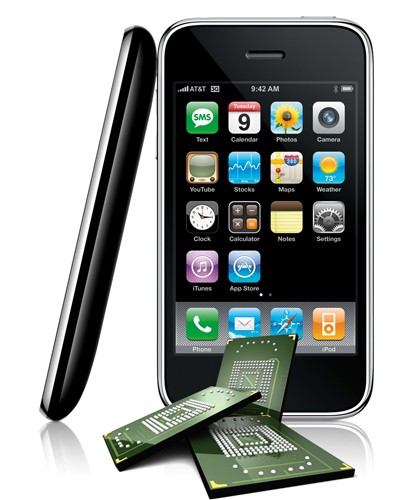
Daaaamn, talk about clout. If DigiTimes' sources are correct, then Samsung, the world's primary supplier of flash memory, just told its non-Apple customers to suck it in favor of a "large batch of orders" it received from Cupertino. The order is said to be for 50-million "8Gb-equivalent" (we assume they mean gigabyte, or GB) NAND chips "mainly for use in Apple's iPhone." This order follows a June procurement for 25 million of the same chips. In response, Samsung has reportedly told its lesser customers that it would "sharply cut supply" of NAND to them while the order is being fulfilled. The shortage is compounded by Samsung lowering its manufacturing output in April and May in an attempt to reduce oversupply. Still, if these numbers are true (they seem high and DigiTimes can be hit or miss with its Apple sources) then the world is about to be awash in iPhone 3Gs come July 11th.
Update: We've given the Gigabits vs. Gigabytes a bit more thought. If it's 50 million 8Gbit chips as stated, they would divide evenly across about 2.1 million 8GB iPhone 3Gs plus another 2.1 million 16GB models. A reasonable production run for Apple's global launch but an order which shouldn't be so taxing on Samsung's production capability. Something doesn't add up.
[Via: Engadget ]
[Tag: apple,digitimes,flash,iphone,iphone 3g,Iphone3g,nand,rumor,samsung ]
Subscribe to:
Posts (Atom)